Many SQL Server performance tuning discussions focus on indexes, statistics, and query rewrites, while one database option often remains overlooked: FORCED PARAMETERIZATION. In environments flooded with ad hoc queries, SQL Server can spend a surprising amount of time compiling nearly identical statements and filling the plan cache with redundant execution plans. While FORCED PARAMETERIZATION is not a silver bullet and won’t benefit every workload, it can be remarkably effective in the right scenarios.
I’ll explore how FORCED PARAMETERIZATION works behind the scenes, how it influences execution plan reuse, and why it can sometimes make a measurable difference to system performance. We’ll also look at its limitations and common misconceptions. By the end, you’ll understand when FORCED PARAMETERIZATION can help reduce plan cache bloat, lower the number of compilations, and ultimately decrease CPU consumption, as well as the situations where it may have little or no impact at all.
What Is FORCED PARAMETERIZATION?
By default, SQL Server treats many ad hoc queries that differ only in their literal values as separate statements, generating and storing individual execution plans for each variation. FORCED PARAMETERIZATION changes this behavior by instructing SQL Server to automatically replace qualifying literal values with parameters during query compilation. As a result, multiple similar statements can reuse a single execution plan instead of creating many nearly identical plans.
The feature was primarily designed for environments that generate large numbers of ad hoc queries, such as vendor applications, ORMs, and web applications where the same query pattern is executed repeatedly with different parameter values. In these scenarios, FORCED PARAMETERIZATION can increase plan reuse, reduce the number of compilations, and help prevent excessive plan cache growth.
It is important to understand that FORCED PARAMETERIZATION is a scalability feature rather than a universal performance fix. While some workloads can benefit significantly from it, others may see little improvement or even encounter challenges related to execution plan quality. Therefore, testing against the actual workload is essential before enabling it in production.
When and Why FORCED PARAMETERIZATION Is Useful
FORCED PARAMETERIZATION is most useful in workloads that generate large numbers of similar ad hoc queries differing only in literal values. Instead of compiling and storing separate plans for each variation, SQL Server can reuse a common parameterized plan.
In such environments, FORCED PARAMETERIZATION can:
- Reduce plan cache bloat by limiting the number of duplicate plans.
- Reduce compilation frequency by increasing plan reuse.
- Lower CPU consumption by spending less time compiling queries.
- Improve scalability of high-throughput OLTP systems.
The greatest benefits are typically seen when the plan cache contains many single-use ad hoc plans and compilations represent a noticeable portion of the workload. Keep in mind that FORCED PARAMETERIZATION is primarily a plan reuse feature, not a query optimization feature. Its value comes from reducing compilation overhead and plan cache pressure rather than producing better execution plans.
When FORCED PARAMETERIZATION Can Become a Problem
While FORCED PARAMETERIZATION can increase plan reuse, it can also lead to suboptimal performance when different parameter values require different execution strategies. In these cases, SQL Server may reuse a single plan for queries that would perform better with different plans. As a result, the savings from reduced compilations can be outweighed by slower query execution.
Common warning signs include:
- Highly skewed data distributions.
- Queries that are sensitive to parameter values.
- Workloads where different literals naturally produce different optimal plans.
- Increased I/O or longer execution times after enabling FORCED PARAMETERIZATION.
For this reason, FORCED PARAMETERIZATION should not be viewed as a universally beneficial setting. It is most effective when the cost of excessive compilations and plan cache bloat outweighs the risk of reusing a less-than-optimal execution plan. As always, workload-specific testing is the key to determining whether the benefits exceed the potential drawbacks.
Demonstrating a Query That Cannot Be Simple Parameterized
To illustrate the impact of FORCED PARAMETERIZATION, let’s start with a query pattern that is not eligible for SIMPLE parameterization. The example uses a join between two tables and dynamically injects a customer identifier into the query text by replacing a placeholder within a string.
This approach mimics the behavior often found in custom applications and legacy code, where SQL statements are constructed dynamically and executed with different literal values. Although the query structure remains identical, SQL Server initially sees each generated statement as a unique query because the customer key is embedded directly in the SQL text.
As a result, repeated executions with different customer identifiers can lead to multiple compilations and multiple cached execution plans. This makes the query a good candidate for demonstrating how FORCED PARAMETERIZATION can increase plan reuse and reduce unnecessary plan cache growth.
Test Scenario
	DECLARE @c_custkey BIGINT = ABS(CHECKSUM(NEWID())) % 1600000 + 1;

	DECLARE	@sqlstmt NVARCHAR(MAX) = '/* Plan Cache relevant */
	SELECT	*
	FROM	dbo.customers AS c
			INNER JOIN dbo.orders AS o
			ON (c.c_custkey = o.o_custkey)
	WHERE	c.c_custkey = %sid%
	ORDER BY
			o.o_orderdate DESC;
	';

	SET	@sqlstmt = REPLACE(@sqlstmt, '%sid%', CAST(@c_custkey AS VARCHAR(16))) + ';';
	EXEC (@sqlstmt);
To demonstrate the effects with FORCED PARAMETERIZATION = SIMPLE, the test repeatedly executes the same query pattern 1,000 times. For each execution, a random customer key is generated with a value between 1 and 1,600,000. This value is then embedded directly into the SQL statement by replacing a placeholder within the query string.
Although the query logic remains unchanged, each execution produces a different SQL text because the literal value of c_custkey is hardcoded into the statement before execution. From SQL Server’s perspective, every generated statement is therefore a unique query.
Without FORCED PARAMETERIZATION, SQL Server may compile and cache a separate execution plan for each distinct statement, potentially resulting in a large number of single-use plans. This behavior makes the workload an excellent candidate for evaluating the effects of FORCED PARAMETERIZATION on plan reuse, compilation activity, plan cache utilization, and CPU consumption.
Results with FORCED PARAMETERIZATION = SIMPLE

Figure 1 shows a summary of SQL Server plan cache statistics for ad hoc queries. The result set contains a single row with the cache type „Adhoc“. A total of 1,000 execution plans are stored in the plan cache, with 1,000 total executions recorded. The highlighted columns indicate that these plans consume approximately 143 MB of memory and have an average use count of 1.0, meaning each plan was executed only once and never reused. The highlighted values emphasize the significant plan cache overhead caused by storing a large number of single-use ad hoc plans.
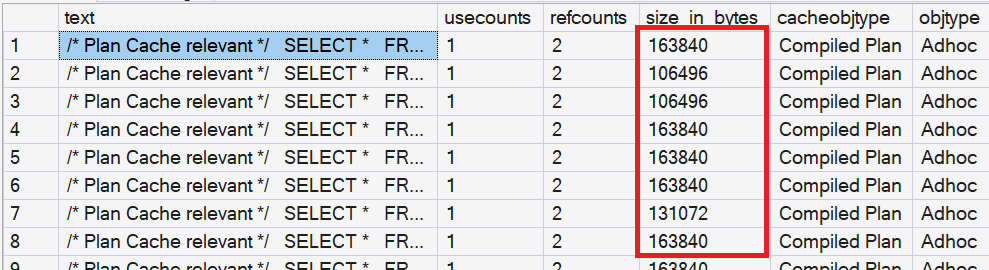
Figure 2 displays multiple rows from a SQL Server plan cache query. The visible columns include text, usecounts, refcounts, size_in_bytes, cacheobjtype, and objtype. Each row represents a separate execution plan associated with a query beginning with the comment /* Plan Cache relevant */. The usecounts column shows a value of 1 for every displayed entry. The highlighted size_in_bytes column indicates that each plan occupies between roughly 100 KB and 160 KB of memory.
Results with FORCED PARAMETERIZATION = FORCED
The Cached Prepared Plan

Figure 3 demonstrates the effect of FORCED PARAMETERIZATION on plan cache utilization. Although SQL Server still stores 1,000 Adhoc entries representing the original query texts, only a single Prepared plan is present in the cache. This Prepared plan records 1,000 executions, indicating that all query variations map to the same parameterized statement. As a result, memory consumption drops significantly from approximately 143 MB to 15 MB. The figure clearly demonstrates improved plan reuse and reduced plan cache bloat.
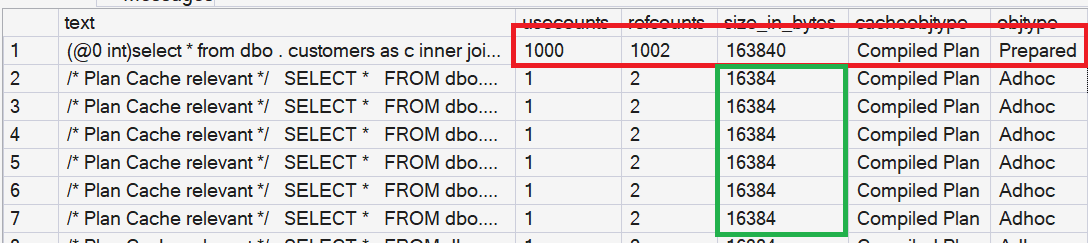
Detailed SQL Server plan cache entries after enabling FORCED PARAMETERIZATION are shown in the screenshot. At the top of the result set is the parameterized query. Highlighted in red, it is classified as a Compiled Plan with an object type of Prepared. Its use count of 1,000 shows that the plan was reused for every execution and occupies 163,840 bytes in the plan cache. Multiple rows beneath the Prepared plan contain the original query text. These entries are classified as Compiled Plan objects with an object type of Adhoc. Each entry has a use count of 1, a reference count of 2, and occupies 16,384 bytes.
The red highlights emphasize the high reuse of the single Prepared plan, while the green highlights show that the individual Adhoc entries are substantially smaller than the shared parameterized plan. Together, the entries illustrate how SQL Server maintains lightweight Adhoc cache objects while associating them with a single heavily reused Prepared plan through FORCED PARAMETERIZATION.
Reference to cached Parameterized Plan
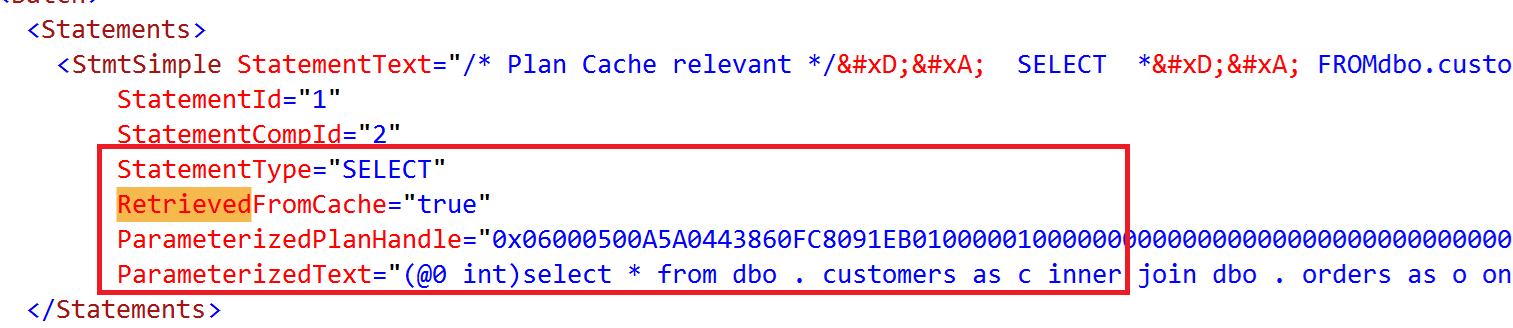
Figure 4 provides direct evidence of how FORCED PARAMETERIZATION is implemented internally by SQL Server. The execution plan XML for an ad hoc query contains both the generated parameterized query text and a ParameterizedPlanHandle attribute. The value stored in ParameterizedPlanHandle acts as a link between the original ad hoc statement and the reusable Prepared plan maintained in the plan cache. At the same time, the ParameterizedText attribute reveals the exact parameterized form generated by SQL Server, replacing the literal customer identifier with parameter @0.
Together, these attributes demonstrate that SQL Server does not simply cache the original query text. Instead, the ad hoc statement is mapped to a parameterized representation, allowing multiple query variations to share a common Prepared plan. This XML entry therefore provides concrete evidence of the relationship between the ad hoc cache entry and the single Prepared plan observed in the plan cache statistics.
Compilations/sec
Compilation Activity Remains High
FORCED PARAMETERIZATION does not eliminate compilation activity. SQL Server must still process and parameterize every incoming SQL statement, which causes the SQL Compilations/sec counter to rise almost one-for-one with Batch Requests/sec. However, the expensive optimization phase appears to be avoided because all statements are mapped to a single Prepared plan that is reused 1,000 times.
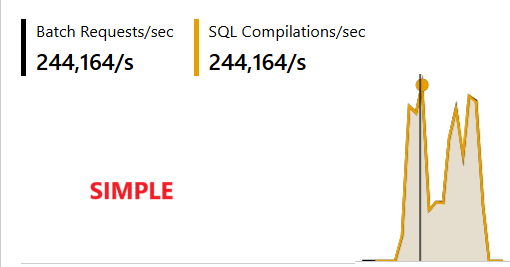
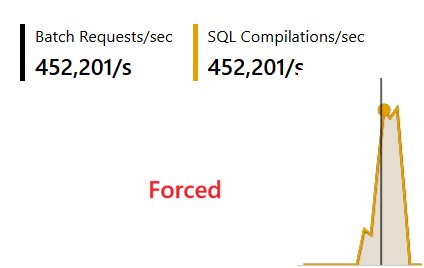
It does not mean SQL Server performed a full cost-based optimization and generated a brand new execution plan! With FORCED PARAMETERIZATION, SQL Server still receives the literal queries!
... WHERE c.c_custkey = 123
... WHERE c.c_custkey = 456
... WHERE c.c_custkey = 789
For each incoming statement must still
- Parse the statement
- Algebrize (binding, name resolutions)
- Determine parameterization eligibility
- Generate athe parameterized form
- Locate the associated Prepared Plan
FORCED PARAMETERIZATION reduces plan generation, not necessarily compilation events. Even though the final executable plan is reused, there is still compilation work being performed on every submitted SQL string.
Great for Plan Cache Efficiency, Not a Magic CPU Optimization
The experiments clearly showed that FORCED PARAMETERIZATION can be highly effective at reducing plan cache bloat. Instead of storing thousands of nearly identical plans, SQL Server was able to map 1,000 different query texts to a single parameterized Prepared plan. This resulted in a substantial reduction in plan cache memory consumption and significantly improved plan reuse.
However, the tests also revealed an important detail that is often overlooked. Even though SQL Server reused a single Prepared plan, the system still reported a compilation rate that closely matched the number of incoming batch requests. The presence of a reusable Prepared plan does not mean that compilation activity disappears. SQL Server must still process, analyze, and parameterize each incoming statement before it can associate the query with an existing parameterized plan. FORCED PARAMETERIZATION is excellent at increasing plan reuse and reducing the memory footprint of the plan cache. What it does not necessarily do is eliminate compilation activity or guarantee lower CPU consumption. While some workloads may experience CPU savings, those savings should be measured rather than assumed. The existence of a heavily reused Prepared plan alone is not evidence that compilation costs have been avoided.
Enable FORCED PARAMETERIZATION when plan cache bloat caused by ad hoc queries is your primary concern. Do not enable it under the assumption that it will automatically reduce CPU usage by eliminating compilations. As always, validate the impact with measurements from your own workload rather than relying on generalized assumptions.
Thank you for reading!